Agricultural Mulch Film Making Machine
- 1–3
- 1–3 m
- Black, transparent, silver-black, punched mulch film
Factory ceiling heights, chiller requirements, electrical loads and resin formulations: everything plant managers need to know before commissioning a mulch film line.
Agricultural mulch film manufacturing is one of the highest-volume, fastest-turnaround segments in blown film extrusion. Because mulch film operates at ultra-thin gauges — typically ranging from **0.006 mm to 0.025 mm (6 to 25 microns)** across layflat widths from 1 to 3 meters — starting a commercial [film production line](https://xinfumachine.com/products) requires precise facility engineering to achieve high line speeds without bubble breaks.
Whether you are setting up a single agricultural line or a centralized agricultural film plant, here is the engineering blueprint our technical team provides for commissioning an [agricultural mulch film making machine](https://xinfumachine.com/products/mulching-packaging-film-machine/agricultural-mulch-film-making-machine).
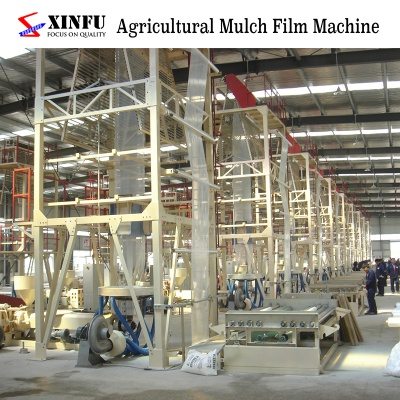
<h2>1. Factory Workshop Dimensions and Tower Clearance</h2> Ultra-thin film extrusion demands sufficient cooling distance between the die face and the upper haul-off rolls. Attempting to fit a high-speed line into a standard 4-meter warehouse ceiling inevitably limits line output.
- **Clear Height Requirements:** A dedicated 1–3 meter [mulch film blowing machine](https://xinfumachine.com/products/mulching-packaging-film-machine) requires a minimum vertical clearance of **6.5 to 8.5 meters** under the crane hook. - **Footprint Sizing:** Allow at least **12 meters in length by 6 meters in width** per extrusion bay. This accommodates the extruder base, die carriage, primary tower, secondary air-cooling passage, and downstream surface-driven center winder with space for roll unloading carts. - **Draft Control:** Isolate the extrusion tower from outside truck bays. Fast-moving air currents greater than 0.8 m/s destabilize high-speed micro-gauge bubbles, causing longitudinal wrinkles.
<h2>2. Electrical and Utility Infrastructure Requirements</h2> Sizing transformer capacity and water chillers correctly prevents costly field commissioning delays:
- **Connected Electrical Load:** A standard Φ55 mm or Φ65 mm single-screw extruder line draws approximately **45 kW to 75 kW connected load**, with an average running power consumption of 30 kW to 52 kW depending on screw RPM and barrel heating efficiency. - **Cooling Water Chiller Sizing:** Stable bubble cooling requires dedicated industrial chillers delivering closed-loop chilled water at **12°C to 16°C** with a flow rate of 4–6 m³/hr per line. Insufficient chiller capacity during summer peaks raises melt frost lines and causes roll blocking. - **Pneumatic Supply:** Air-expanding winding shafts, oscillating haul-off clamps, and auto-splicing cutters require clean, dry compressed air at **0.6 to 0.8 MPa (6–8 bar)** with a consumption rate of 0.3 m³/min.
<h2>3. Typical Resin Formulations and Additive Blends</h2> Producing 8–10 micron mulch film with high elongation and zero pinholes requires balanced polymer selection:
- **Base Polymer (75%–85%):** Linear Low-Density Polyethylene (LLDPE) blown film grade with a Melt Flow Index (MFI/MFR) of **0.8 to 2.0 g/10 min** (e.g., C4-butene or C6-hexene copolymers). - **Toughness Enhancer (10%–15%):** Metallocene LLDPE (mLLDPE) significantly improves dart impact strength and tensile elongation, allowing producers to down-gauge film from 12 microns down to 8 microns without tearing on tractor-mounted mulch laying rigs. - **Processing & Bubble Stability Aid (5%–10%):** Low-Density Polyethylene (LDPE) fractional melt grade adds melt elasticity and stabilizes bubble formation in the lower tower. - **Functional Masterbatches:** 2%–3% UV weatherable stabilizer (HALS) for 3–6 month field life, plus 1%–2% slip and anti-block masterbatch to ensure easy unrolling on agricultural fields.
<h2>4. Downstream Punching and Auto-Width Control Features</h2> Modern commercial growers increasingly demand pre-punched holes for seedling emergence or specialized dual-color micro-embossed films:
- **In-Line Rotary Punching Units:** Integrated downstream before the winder, mechanical or cold-punch rotary hole units produce clean-cut planting apertures at customizable spacings without tearing the moving web. - **Automatic Width Control & Edge Trimming:** High-precision ultrasonic sensor arrays continuously monitor web width, signaling motorized sizing cage adjustments and inline razor edge trimmers to ensure uniform master rolls ready for automatic field laying machines.
<h2>Summary Commissioning Checklist for Entrepreneurs</h2> Before ordering your production line equipment, verify:
1. Workshop hook height (minimum 7.5 meters recommended). 2. Three-phase power stability (380V / 415V / 480V 50/60Hz). 3. Closed-loop chiller capacity matched to peak summer ambient temperatures. 4. Local resin supply contracts for C6 LLDPE and mLLDPE grades.
Xinfu provides turnkey agricultural film machinery manufacturing, plant layout CAD drawings, and on-site technician commissioning. Connect with our engineering specialists on our [contact page](https://xinfumachine.com/contact) or via WhatsApp at +86 150 0683 0110 for comprehensive plant quotes.