
Engineering Standards
HDPE Geomembrane Thickness Guide: 0.5 mm to 2.5 mm Applications and GRI-GM13 Specifications
From 0.5 mm aquaculture liners to 2.5 mm hazardous waste containment: how engineers match HDPE geomembrane thickness to site conditions and GRI-GM13 test criteria.
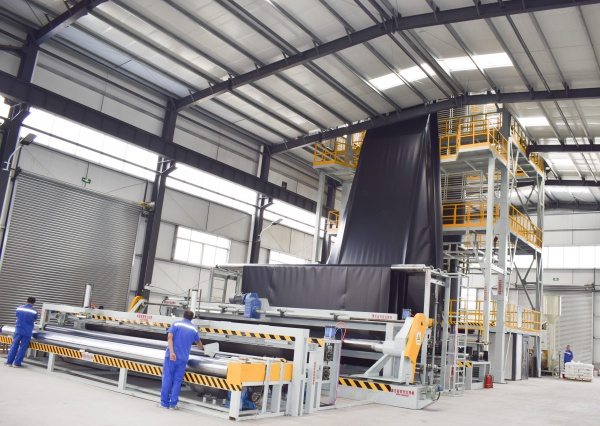
In containment engineering, choosing the correct thickness for high-density polyethylene (HDPE) liners is the defining factor between a 30-year impermeable barrier and catastrophic containment failure. For manufacturers investing in a [geomembrane machine](https://xinfumachine.com/products/geomembrane-machine), understanding the global engineering standard — **GRI-GM13 published by the Geosynthetic Institute (GSI)** — is essential to producing spec-compliant liners that pass international project tenders.
Geomembrane liners produced on modern blown film extrusion systems range from **0.5 mm (20 mil) up to 2.5 mm (100 mil)** in standard seamless widths of 4 to 8 meters. Here is the engineering rationale behind each thickness class and how equipment design guarantees compliance.
<h2>1. 0.50 mm to 0.75 mm (20 to 30 mil): Aquaculture & Agricultural Water Reservoirs</h2> Thin-gauge HDPE liners are predominantly specified where hydrostatic head pressure is low and the subgrade consists of compacted, rock-free sand or fine silt.
- **Primary Applications:** Commercial shrimp and fish ponds, agricultural irrigation canals, golf course decorative lakes, and temporary stormwater retention basins. - **Key Performance Challenge:** High tear resistance and puncture resistance during manual liner deployment over irregular berms. - **Manufacturing Machinery Match:** Standard [3-layer geomembrane blowing machines](https://xinfumachine.com/products/geomembrane-machine/3-layer-geomembrane-blowing-machine) configured with high-output fractional melt HDPE extruders and smooth lip profiles.
<h2>2. 1.00 mm (40 mil): Secondary Containment and Wastewater Lagoons</h2> A 1.0 mm liner represents the minimum industry standard for municipal wastewater treatment facilities and agricultural manure storage lagoons.
- **Primary Applications:** Municipal sewage oxidation ponds, dairy manure holding pits, biogas digester covers, and secondary containment under industrial chemical storage tanks. - **Performance Requirements:** Resistance to biological anaerobic degradation, moderate chemical resistance (pH 3 to 11), and high weldability during hot-wedge seaming. - **GRI-GM13 Baseline:** Minimum tensile strength at yield of 15 kN/m and elongation at break exceeding 700%.
<h2>3. 1.50 mm (60 mil): The Global Benchmark for Municipal Solid Waste (MSW) Landfills</h2> Across the Americas, Europe, and Asia, environmental protection agencies mandate **1.5 mm (60 mil) as the absolute legal minimum thickness** for bottom composite liner systems in municipal solid waste (MSW) landfills.
- **Primary Applications:** Municipal landfill cell base liners, capping/closure covers, leachate collection evaporation ponds, and highway runoff retention reservoirs. - **Critical Stress Factors:** Heavy overburden pressures from tons of waste, mechanical puncture hazards from un-screened aggregates, and aggressive chemical leachates containing volatile fatty acids. - **Machinery Feature:** Requires heavy-duty [geomembrane production lines](https://xinfumachine.com/products) equipped with automated oscillating haul-off units to randomize gauge variations across the entire roll width.
<h2>4. 2.00 mm to 2.50 mm (80 to 100 mil): Mining Heap Leaching & Hazardous Chemical Storage</h2> When environmental stakes are highest, 2.0 mm and 2.5 mm smooth or textured HDPE liners provide the safety factor required by mining engineers and petrochemical operators.
- **Primary Applications:** Gold, silver, and copper heap leaching pads, uranium mine tailings storage facilities (TSF), industrial hazardous waste secure landfills, and ash ponds at coal-fired power stations. - **Extreme Operating Conditions:** Liners withstand acidic cyanide leach solutions (pH < 2 or > 12) under massive ore stack heights exceeding 50 to 100 meters, creating compressive loads over 1,000 kPa. - **Textured Surface Requirement:** On steep side slopes, smooth liners cause slope instability. A [4-layer geomembrane blowing machine](https://xinfumachine.com/products/geomembrane-machine/4-layer-geomembrane-blowing-machine) allows nitrogen foaming injection or texturing agent co-extrusion to produce single- or double-sided structured rough surfaces that increase the friction interface angle with geotextiles from 11° to over 28°.
<h2>5. Understanding the GRI-GM13 Testing Standard</h2> The GRI-GM13 standard governs smooth and textured HDPE geomembranes across four critical testing dimensions:
1. **Density (ASTM D1505 / D792):** Must meet ≥ 0.940 g/cm³ before carbon black addition to ensure high stiffness and chemical inertness. 2. **Carbon Black Content & Dispersion (ASTM D1603 / D5596):** 2.0% to 3.0% finely dispersed carbon black protects the polymer backbone against UV photo-oxidation for over 50 years of outdoor exposure. 3. **Stress Crack Resistance (SP-NCTL - ASTM D5397):** Must exceed **500 hours** without brittle failure under sustained mechanical stress and surfactant exposure. 4. **Oxidative Induction Time (OIT - ASTM D3895):** Standard OIT ≥ 100 minutes, ensuring sufficient antioxidant additive reserves to resist thermal-oxidative degradation.
<h2>Summary Equipment Sizing for Geomembrane Producers</h2> Successfully bidding on international infrastructure projects requires an extrusion line capable of tightly controlling thickness tolerance across widths up to 8 meters. Standard blown film lines with older spiral dies suffer from gauge variation exceeding ±15%, failing GRI-GM13 thickness verification.
Xinfu manufactures heavy-duty geomembrane blowing machinery from 4 to 8 meters width with thickness capabilities from 0.5 to 2.5 mm, engineered specifically to pass GRI-GM13 inspection. Review our complete machinery specifications on our [contact page](https://xinfumachine.com/contact) or connect directly with our engineering team on WhatsApp at +86 150 0683 0110.
Recommended Production Lines
More Technical Articles
- See You at Chinaplas 2025 — Xinfu Booth 3-Y09 (2025-03-06)
- 4 Sets of 5-Layer Greenhouse Film Blowing Machine Succeed for Initial Running (2018-09-29)
- Advantages of Punched Mulch Film (2020-12-09)