
Technology
Using Recycled HDPE in a 3-Layer Geomembrane Production Line: What the Structure Actually Buys You
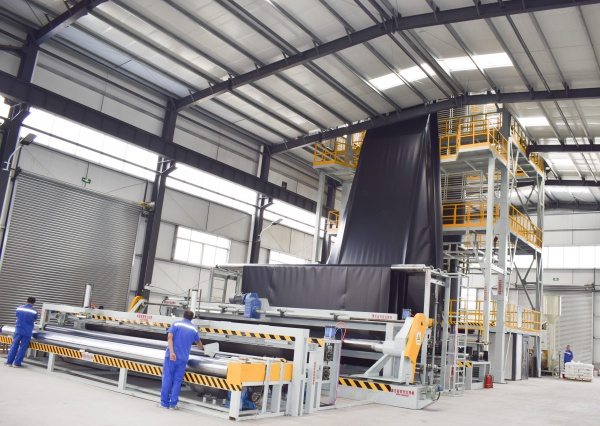
A three-layer co-extrusion geomembrane production line separates outer skins from the core so recovered polymer can be placed in a controlled layer.
A geomembrane buyer usually has two demands at once: the liner has to satisfy the project specification, and the tonne cost has to survive the local market. On a single-layer blown film line those two demands fight each other directly — every kilogram of regranulate goes into the same melt that has to deliver the tensile and environmental-stress-cracking performance the engineer wrote into the tender.
A three-layer co-extrusion geomembrane production line breaks that deadlock. Three extruders feed one co-extrusion die, which means the melt is laid down as three distinct skins of material in a single pass rather than one blended stream. That separation is the whole commercial argument for 3-layer over single-layer when you want to use recovered polymer.
<h2>What the layer split is for</h2> On a [3-layer geomembrane blowing machine](https://xinfumachine.com/products/geomembrane-machine/3-layer-geomembrane-blowing-machine), the usual recipe puts **virgin HDPE in the two outer skins and regranulate or black masterbatch in the core**. The outer skins are what the site inspector is actually testing against: they carry the surface that will be welded, the surface exposed to UV during storage, and the surface in contact with the subgrade and the drainage geotextile. The core carries thickness.
Put recovered resin where the specification is not looking, and you keep the properties that matter while lowering the resin bill. That is why, on our line FAQ, the answer to "can the line run recycled material?" is yes — with the qualification that the 3-layer structure is precisely what makes it a controlled decision instead of a guess.
<h2>Where this matters on the machine itself</h2> Being able to run three different melts at once is not a software feature. It changes what the line has to deliver physically:
- **Three extruders, sized as a set.** Each layer has its own melt demand, and a thick geomembrane is melt-delivery-limited. Our geomembrane lines use dedicated high-torque extruders matched to the die rather than borrowed from a thin-film platform. - **A large crosshead die built for the layer structure.** [Die heads](https://xinfumachine.com/products/die-head-mold/die-head-mold-for-blowing-machines) are machined in our own plants, which is what lets a layer recipe change become an internal engineering revision instead of waiting on an outside supplier. - **Cooling, haul-off and winder rated for the thick product.** A 0.5–2 mm, 6–8 m folded bubble needs an oversized cooling frame, a double-station haul-off and a centre/surface winder with real torque. Specify these against your thickest product, not your thinnest.
Standard output on this configuration is **3-layer HDPE geomembrane, 6–8 m folded width, 0.5–2 mm thick**, with US GM13 practice as the quality reference. The wider 4–8 m band is deliberate: fewer folds per square metre means fewer field welding seams on site, and seams are where liner risk concentrates.
<h2>When three layers is not enough</h2> If your project mix includes **textured liner for side slopes**, three layers is the wrong starting point. Texture and a weldable smooth margin cannot be produced from the same channel, so you want a [4-layer co-extrusion geomembrane machine](https://xinfumachine.com/products/geomembrane-machine/4-layer-geomembrane-blowing-machine): it keeps the full three-layer capability, adds a dedicated texture layer, and blows the sheet with a smooth edge so overlap seams stay weldable on site. It also extends the thickness range to 2.5 mm and gives formulators a fourth dosing channel for additives, colour or an engineering core.
In practice many producers buy the 4-layer line precisely so that one machine can take both the standard liner orders and the higher-margin textured orders.
<h2>What to settle before you choose</h2> Before anyone can size a [geomembrane line](https://xinfumachine.com/products/geomembrane-machine) honestly, four inputs have to be fixed: target folded width, the thickness range you must hold, which project standard the liner is tested against, and what fraction of recycled content you intend to run. The first three decide the machine; the fourth decides how much you get out of having three layers at all.
Send those four numbers to Xinfu on the [contact page](https://xinfumachine.com/contact) — WhatsApp +86 150 0683 0110 or [email protected] — and we will propose a configuration with the extruder, die and winder set to match.
Recommended Production Lines
More Technical Articles
- See You at Chinaplas 2025 — Xinfu Booth 3-Y09 (2025-03-06)
- 4 Sets of 5-Layer Greenhouse Film Blowing Machine Succeed for Initial Running (2018-09-29)
- Advantages of Punched Mulch Film (2020-12-09)