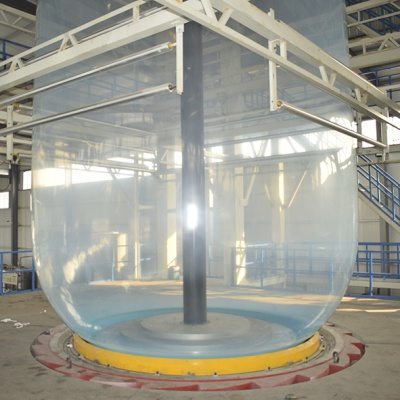
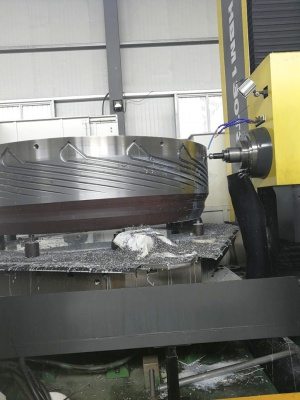
Die Head & Mold for Blown Film Machines
- Spiral die · 3-layer stack · 5-layer stack · geomembrane die
- Agricultural, mulch, packaging, greenhouse & geomembrane blowing machines
- New dies, refurbishment, upgrading layer count
Prevent gauge variation, die lines and melt leakage: a practical engineering protocol for disassembling, cleaning, and hot-torquing blown film die heads.
In blown film extrusion, the [die head](https://xinfumachine.com/products/die-head-mold/die-head-mold-for-blowing-machines) is a precision piece of thermal-fluid tooling. Operating under continuous pressures of 150 to 350 bar and temperatures exceeding 180°C to 240°C, the die head's internal spiral channels must maintain micron-level concentricity to ensure uniform wall thickness around the entire bubble circumference.
Over prolonged production campaigns, degraded resin and carbonized additives accumulate along the flow paths and die lips. This buildup creates optical die lines, gauge variation, and bubble wander. Here is the operational maintenance protocol our manufacturing engineers follow to preserve die tolerances and prevent melt leakage.
<h2>1. Warning Signs That Mandate Die Cleaning</h2> Before scheduling line downtime, plant technicians should monitor these four key indicators:
- **Persistent Die Lines:** Vertical scratches or streaks that remain stationary on the running bubble even when the air ring is rotated. - **Circumference Gauge Bands:** Chronic thin or thick spots in the film web that cannot be corrected through air ring tuning or heater zone adjustments. - **Carbon Specks & Gel Contamination:** Periodic release of burnt black specks into the film skin, compromising waterproof integrity in [geomembrane machines](https://xinfumachine.com/products/geomembrane-machine) liners. - **Interfacial Melt Seepage:** Visible polymer drool weeping between die plate splits or heater band junctions, signaling loss of bolt pre-load.
<h2>2. In-Line Chemical Purging vs Complete Teardown</h2> When switching between incompatible polymer formulations (such as transitioning from fractional-melt HDPE to metallocene LLDPE or black masterbatch), complete mechanical teardown is not always mandatory.
- **In-Line Purge Protocol:** Flush the line with high-molecular-weight purging compounds or cast acrylic purging masterbatch at 50% screw speed. Purging scrubs polymer stagnation zones without cooling the die. - **When Mechanical Teardown Is Mandatory:** If carbon buildup has adhered to chrome-plated spiral mandrel flutes or when upgrading layer counts on [co-extrusion blown film lines](https://xinfumachine.com/products/greenhouse-film-machine), physical teardown is the only method to restore pristine internal surface finish.
<h2>3. Tooling Discipline: Strict Brass and Copper Protocol</h2> Modern spiral die heads and stacked pancake plates feature mirror-polished, hard-chrome plated, or nickel-plated flow channels. Using improper tools permanently ruins the micro-inch surface finish:
- **Mandatory Tools:** Specialized brass scrapers, copper gauze pads, pure aluminum drift pins, and high-temperature silicone release paste. - **Strictly Prohibited:** Steel screwdrivers, hardened scrapers, wire wheels, or oxy-acetylene torch flame burning. Steel gouges create local shear discontinuities that produce permanent polymer drag marks.
<h2>4. Step-by-Step Disassembly Sequence</h2>
1. **Pre-Heating at Idle:** Heat the entire die head uniformly to 180°C–200°C so polymer residue remains pliable during bolt loosening. Never attempt disassembly on a cold die. 2. **Symmetrical Bolt Loosening:** Loosen high-tensile die bolts in a crisscross diagonal pattern (1/4 turn per pass) to prevent asymmetric flange warping. 3. **Vertical Hydraulic Hoisting:** Use an overhead gantry crane with calibrated guide pins to lift die sections vertically. Never pry adjacent die plates apart horizontally with crowbars. 4. **Immediate Brass Scraping:** As soon as a plate is separated, wipe away molten polymer with copper mesh and brass blades while the metal retains residual heat.
<h2>5. Hot-Torquing and Leak Prevention During Reassembly</h2> Melt leakage across die plate splits is almost always caused by improper cold-torquing. Because tool steel expands significantly as temperatures rise from ambient to 220°C, bolt tension changes dramatically.
- **Anti-Seize Lubrication:** Coat all high-tensile bolt threads with nickel-based or copper-based anti-seize compound rated for 800°C+ service. - **Two-Stage Torque Specification:** Torque bolts cold to 70% of nominal torque specification using a calibrated torque wrench in star patterns. Once the die reaches full operating temperature (stabilized for at least 2 hours), perform final **hot-torquing to 100% rated torque**. - **Die Lip Alignment:** Verify die gap concentricity with feeler gauges at 12 radial points (target tolerance ±0.02 mm) before introducing polymer melt.
<h2>Summary Maintenance Schedule for Extrusion Plants</h2>
- **Daily:** Brass-blade scrape die lips; inspect heater band amperage. - **Weekly:** Purge extrusion system during color/resin transitions; check thermocouple probe contact. - **Semi-Annually:** Deep clean die lip rings and replace worn cartridge heaters. - **Annually:** Full die disassembly, ultrasonic cleaning of spiral mandrel flutes, and optical inspection of plating thickness.
Xinfu manufactures precision spiral and multi-layer co-extrusion die heads in our own machine shops, providing re-machining, refurbishment, and layer-upgrades. Contact our engineering division on our [contact page](https://xinfumachine.com/contact) or via WhatsApp at +86 150 0683 0110 for die inspection and replacement services.